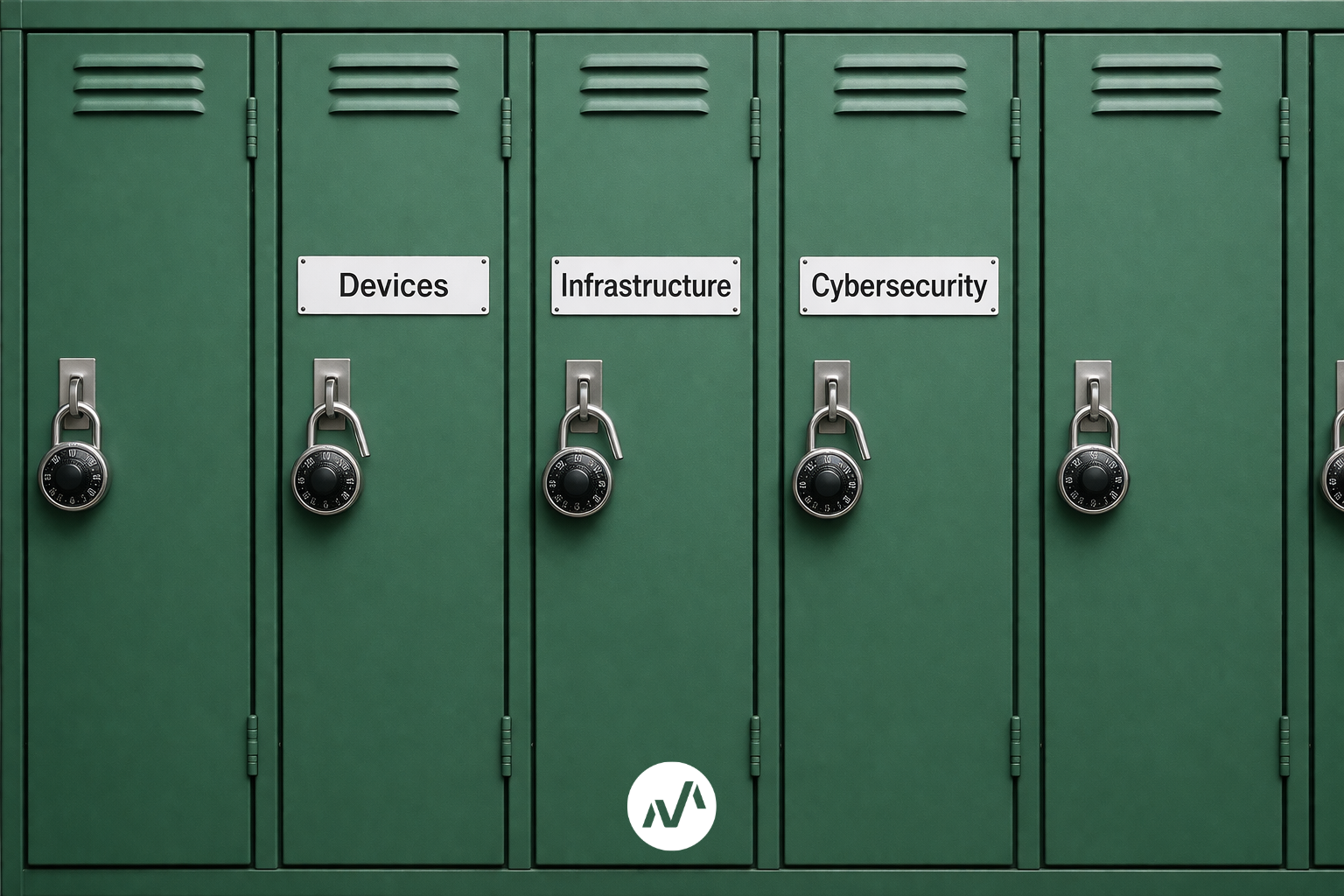
Spring Break just ended for most schools. Students are back, staff is catching up, and IT teams are dealing with the usual post-break surprises:
- Devices that didn’t get updated.
- Systems that didn’t reconnect cleanly.
- Passwords forgotten.
- Machines that probably should have been retired last year.
It’s also a good reminder of something CISA highlights in its Zero Trust model: Devices are the second pillar for a reason.
Why Device Risk Builds Quietly in Every School
If Identity is where most breaches start, Devices are where they usually spread.
In independent schools especially, device risk tends to build slowly. Not because teams aren’t doing the right things, but because small IT teams are managing large, constantly changing environments with limited time.
Every year it’s the same balancing act:
- New student devices
- Faculty laptops Lab equipment
- Aging network gear
- Budget constraints
- Limited staff
Over time, what starts as normal operational reality becomes technology debt. And eventually technology debt becomes cyber risk.
When we look at school environments in Florida, we usually see some combination of:
- Devices past lifecycle
- Inconsistent patching after breaks or semesters
- Limited visibility into what is actually active
- Flat networks that make containment difficult
- Security tools that are only partially deployed
None of these individually create major incidents. But together they create the conditions where one compromised account or phishing email can turn into a much bigger operational issue.
This is where the conversation needs to shift from device management to device risk.
The real question isn’t how many devices you bought.
It’s how many you truly control.
Zero Trust in a School Environment Starts with Visibility
One thing Spring Break tends to highlight is device visibility. Students travel. Staff work remotely. Devices leave the network. When everything reconnects, most organizations discover they don’t have as much visibility as they thought.
That’s not unusual. It’s exactly why CISA emphasizes device inventory and lifecycle management as part of Zero Trust fundamentals. You can’t secure what you can’t fully see or manage.
The schools that are ahead here usually aren’t doing anything complicated. They’re just disciplined about a few fundamentals:
- Maintaining an accurate device inventory
- Setting lifecycle expectations instead of stretching equipment indefinitely
- Keeping patching consistent even during breaks
- Deploying endpoint protection everywhere, not just most places
- Segmenting critical systems so one issue doesn’t spread
Not exciting. Just mature.
A simple leadership question worth asking after any long break:
If a compromised or outdated device reconnected to your network tomorrow, how quickly would you know and how confidently could you contain it?
That answer usually tells you more about device maturity than any inventory spreadsheet.
What makes this important is device problems rarely show up as security issues first. They usually show up as reliability problems. Slow systems. Access issues. Classroom disruptions. Security exposure tends to follow operational instability.
This is why device security is really about stability as much as protection.
Good device discipline reduces cyber risk, but it also makes life easier for small IT teams and reduces unexpected disruptions during the school year.
If you’re not fully confident where device risk may be building, we periodically work with school leadership teams in Florida on executive cyber risk briefings to help translate technical gaps into operational risk leadership can actually plan around.
Managed Services Group, Inc is a Maitland, FL based MSP and MSSP that has served the state of Florida for over two decades. Providing expert Tier 3 technical support, vendor management, and administrative work, we are committed to a simple, secure, and scalable approach to IT for any project and any business. Backed by industry-best standards and a SOC 2 Type 2 certification, we are committed to upholding the bar of cyber safety and cyber excellence across Florida.